
Documentary and analytical report
Violations by the rebel Rapid Support Forces militia against Christians and churches in Sudan
The Church in the Militia’s Line of Fire
Documentation and analysis of events in Khartoum, Gezira, Darfur and Kordofan from April 2023 to October 2025, and State policy on protecting and rehabilitating places of worship
Advisory Board of the Transitional Sovereignty Council · Khartoum · November 2026
In Sudan the church, like the mosque and the khalwa, is a school, a clinic and a shelter in hard times, and one of the oldest community institutions on which coexistence in this country was built. Whoever attacks it wounds the whole national fabric before wounding any single denomination.
The evidence drawn from the reliable sources reviewed in this report shows that the militia targeted Sudanese Christians on religious grounds, as the words and acts of the perpetrators attest. Its documented practices against them fall into seven patterns: detention and intimidation; abuse, beatings and killing; systematic looting of property; religious insults; coercion to renounce their faith; the use of places of worship as barracks and their desecration; and declared intent to sexually assault girls.
This record has reached the international institutions concerned with religious freedom. In its annual report released in March 2026, the United States Commission on International Religious Freedom recommended, for the first time, that the RSF militia be designated an “Entity of Particular Concern”, a designation reserved for non-state groups engaged in particularly severe violations of religious freedom.1
The toll in numbers
Executive summary
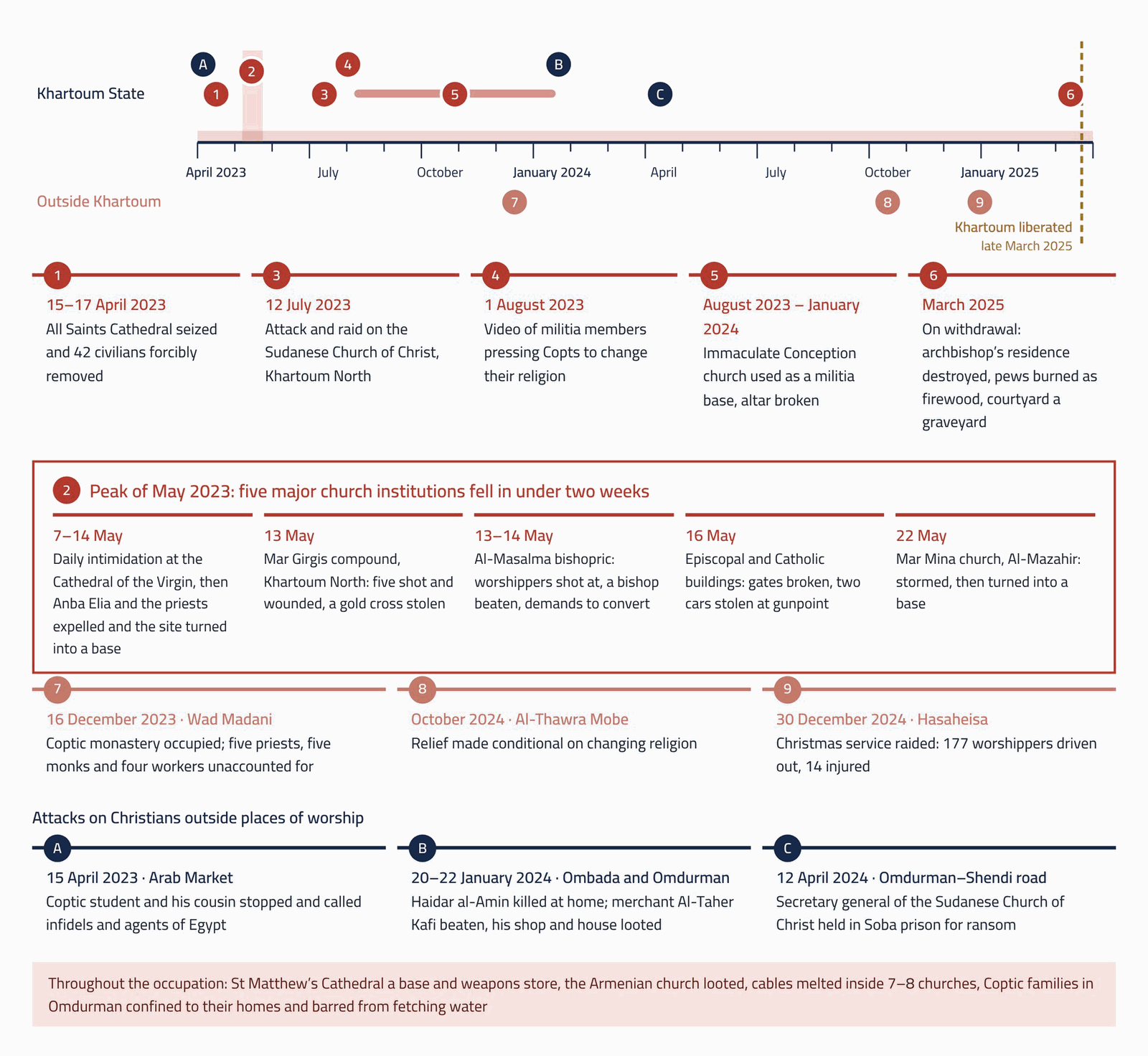
On the third day of the war ignited by the RSF rebellion on 15 April 2023, militia members stormed All Saints Cathedral in Khartoum and forcibly removed forty-two civilians who had taken refuge there, among them the Archbishop of the Episcopal Church and his family.2 Over the following four weeks the Coptic cathedral, the Mar Girgis bishopric and other church compounds in Khartoum, Omdurman and Khartoum North fell in turn, following a fixed pattern: forced entry, looting, expulsion of those inside, and conversion of the site into a barracks.
The report documents twenty-two church sites damaged in Khartoum State during the war. The militia is proven to have stormed and used thirteen of them, and its members or affiliates were observed in the grounds of at least seven.3 By mid-2024 the National Investigation Committee had recorded fifty-one churches in the state as looted or robbed.4 The analysis concludes that the church served three purposes in the militia’s calculations: a fortified military position near the Republican Palace, the airport and the bridges; a source of plunder where the first question asked was about gold; and an arena of humiliation where worshippers were called infidels and told, under threat, to abandon their faith.
The assault went beyond church walls into the daily lives of Christians. Coptic families in Omdurman recounted that militia members held relatives captive in their own homes and prevented them from going out to fetch water.5 Officials of the Sudanese Church of Christ reported that its secretary general was stopped on his way to Shendi, taken to Soba prison, and held for ransom.6 These testimonies combine religious humiliation, extortion and looting.
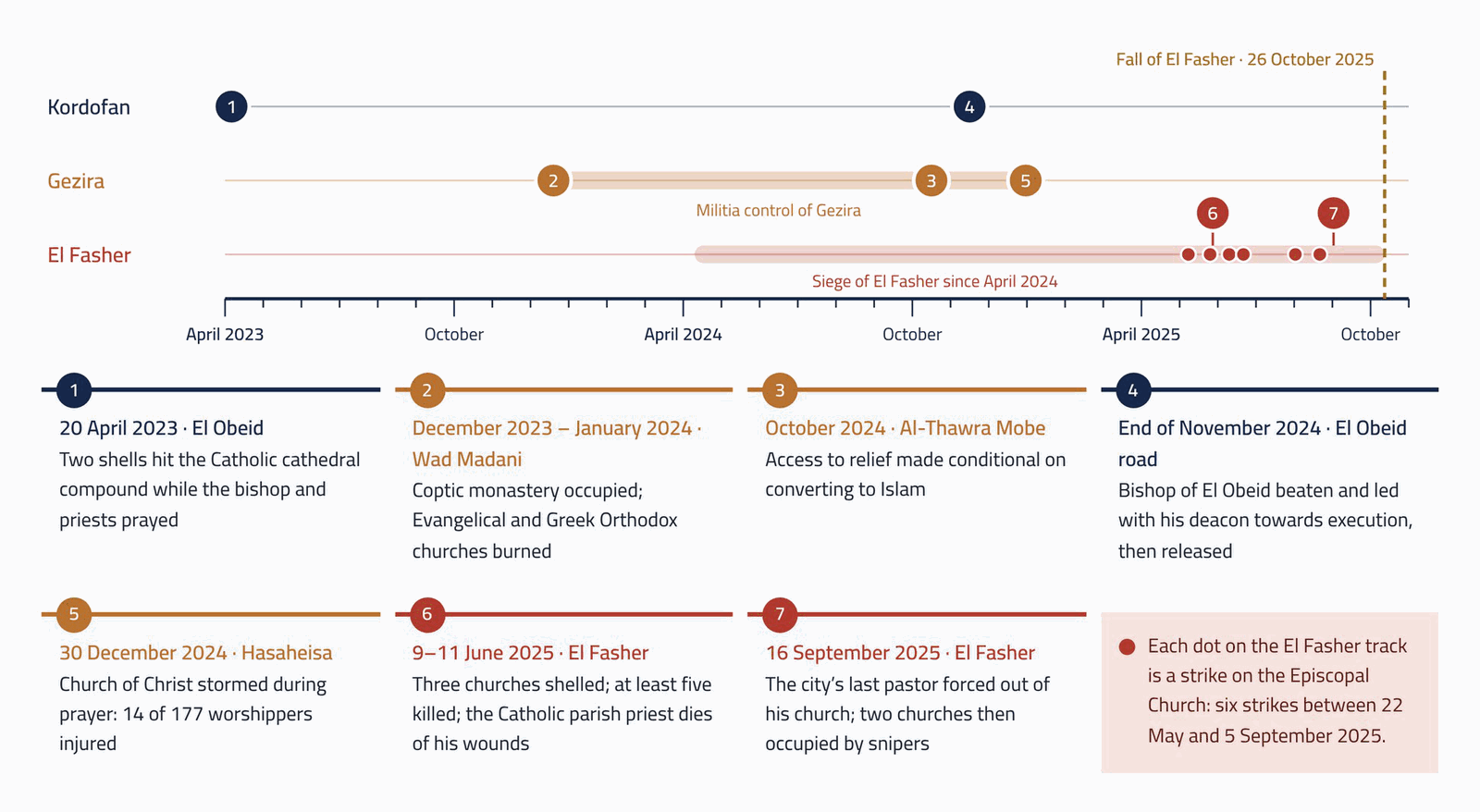
The pattern recurred outside the capital wherever the militia took control or laid siege. In Gezira it turned the Coptic monastery of Wad Madani into a base, burned the state’s largest church, and stormed the Church of Christ in Hasaheisa while worshippers were inside.7 In El Fasher it shelled three churches between 9 and 11 June 2025, killing at least five people and fatally wounding the Catholic parish priest, and later forced the last remaining pastor out of the city.8 In Kordofan the Bishop of El Obeid was beaten and led towards execution before being released.9
The report sets this conduct against the conduct of the State in the same war. In Al-Shajara, south of Khartoum, the Armed Forces protected the Catholic compound of Dar Mariam for sixteen months under militia siege, supplied those inside with food, water and medicine, and in July 2024 evacuated the sisters, the priest and those with them across the White Nile. After the liberation of the capital, the Chairman of the Transitional Sovereignty Council pledged to rehabilitate the Coptic church in Omdurman and ordered the restoration of the Cathedral of the Virgin Mary in Khartoum. In June 2026 he ordered four churches to be repaired and rebuilt at State expense, and the work is under way.
How the attacks unfolded
Key findings
- The militia stormed, occupied and looted at least thirteen churches in Khartoum State, including the Episcopal, Coptic and Catholic cathedrals.
- The assault extended beyond the churches: families held in their homes and denied water, killings and looting in Ombada and Omdurman, and a church leader detained for ransom.
- The pattern recurred outside the capital: a monastery and churches in Gezira occupied and burned, three churches in El Fasher shelled within three days and the Catholic parish priest dying of his wounds, and the Bishop of El Obeid led towards execution.
- Religious insults and demands that Christians renounce their faith recurred in Khartoum and then in Gezira, and the militia has not announced a single act of accountability.
- In this targeting, motives of overt religious coercion combined with calculations of military positioning, the pursuit of spoils and predatory looting. It is fed by a sense of ethnic and religious supremacy and enabled by impunity.
- The militia projected a “secular” discourse aimed at foreign audiences while occupying churches for twenty-three months.
- Wherever the Armed Forces were present, the church and those inside it were protected; after liberation the State took charge of rehabilitating what the militia had destroyed.
- The documented acts amount to war crimes under international humanitarian law and require accountability and reparation.
Recommendations
- 90 days
Field survey
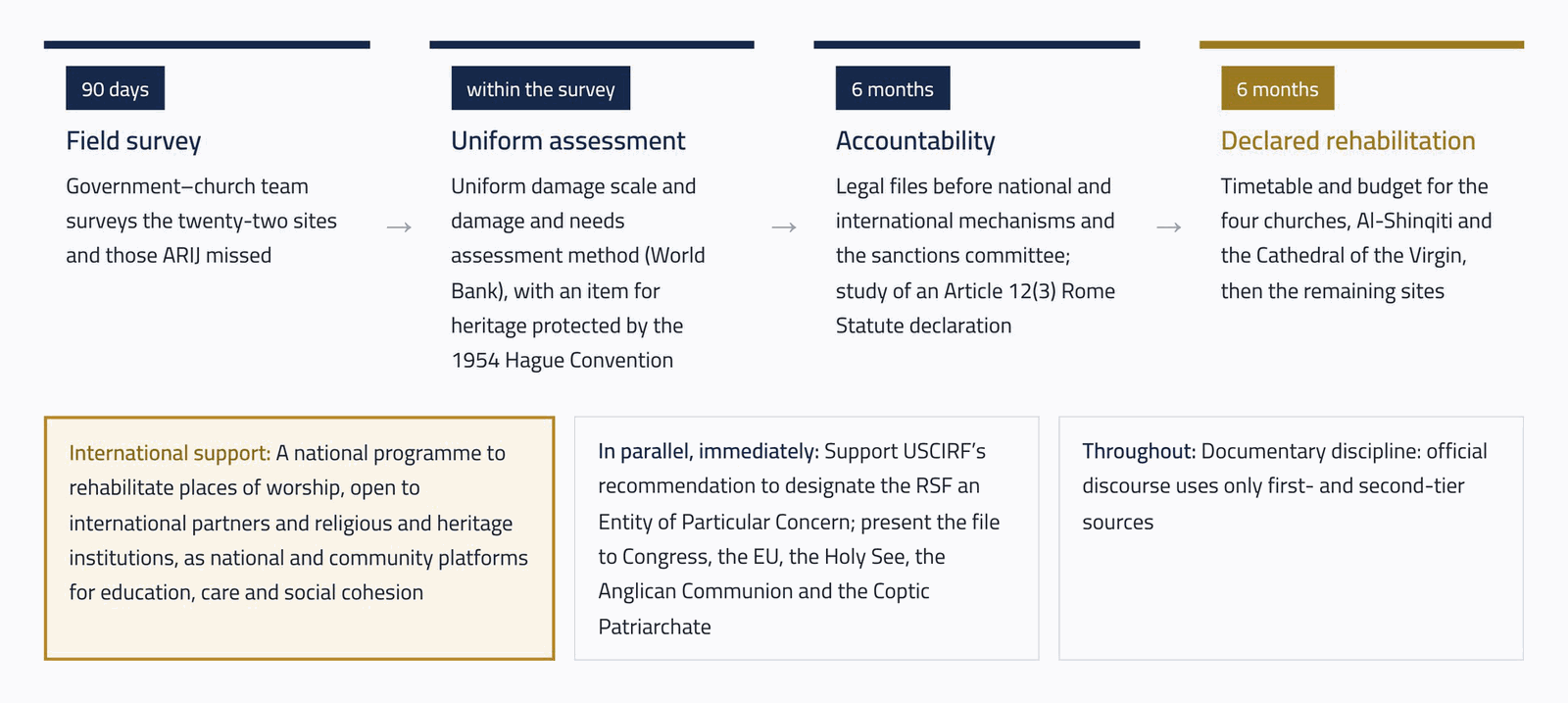
Form a joint team of the competent government bodies, the Sudan Council of Churches and the owning denominations to survey the twenty-two sites, together with those recorded by the National Investigation Committee but not covered by the ARIJ investigation, using an internationally recognised damage assessment methodology and linking each item to the perpetrator and the evidence.
- 6 months
Accountability
Prepare complete legal files on the attacks on churches and on Christians outside them, in the capital and the states, in coordination with the National Investigation Committee, and place them before the competent national and international mechanisms, and before the sanctions committee established by Security Council resolution 1591 and its Panel of Experts. The International Criminal Court’s current jurisdiction under Security Council resolution 1593 is limited to Darfur; extending it to crimes committed in Khartoum requires a declaration under Article 12(3) of the Rome Statute, and the Advisory Board recommends studying the option of issuing one.
- Immediate
Diplomatic action
Support the recommendation of the United States Commission on International Religious Freedom to designate the RSF an Entity of Particular Concern, and present this file to the U.S. Congress, the European Union, the Holy See, the Anglican Communion, the Coptic Patriarchate and the World Council of Churches.
- 6 months
A declared national rehabilitation programme
Publish a timetable and budget for rehabilitating the four churches, the Al-Shinqiti church and the Cathedral of the Virgin Mary, and extend the programme to the remaining sites in partnership with the Sudan Council of Churches.
Mobilising international support for the rehabilitation of places of worship in Sudan
Invite international partners, UN heritage agencies, global religious institutions and donors to contribute to rehabilitating places of worship damaged in the war, churches and mosques alike, through a national programme supervised by the State with the participation of the denominations. Places of worship are national and community platforms of great importance: they provide education, health care and relief and preserve social peace, and restoring them to service is a condition for the return of the displaced and the stability of neighbourhoods.
- Ongoing
Documentary discipline
Limit official discourse to what is stated in first- and second-tier sources. Exaggerated figures hand the militia and its supporters the opening they seek to discredit the entire file.
Conclusion
The cost of looking away
What is required is to judge the militia by its documented acts rather than by its published charters. On 14 May 2023 it expelled the Coptic Bishop of Khartoum from the Cathedral of the Virgin Mary and turned it into a base. On 12 April 2026 the same bishop received the Chairman of the Transitional Sovereignty Council in the same cathedral, and the order was given to rebuild it. Preserving religious diversity in Sudan means supporting the State that is rebuilding the churches and holding to account the militia that destroyed them.
The full report
How to cite: Advisory Board of the Transitional Sovereignty Council, “The Church in the Militia’s Line of Fire: Violations by the rebel Rapid Support Forces militia against Christians and churches in Sudan”, Khartoum, November 2026.
Contents
- Foreword
- Executive Summary
- Part One · Documentation
- 1Methodological Framework
- 2The Capital under Militia Control
- 3Record of Violations
- 4Toll of Damage to Church Property
- 5Testimonies of Victims and Witnesses
- 6Beyond Khartoum State: Gezira, Darfur and Kordofan
- Part Two · Analysis
- 7The Church in the Militia’s Logic
- 8Recruitment Structure and Its Effect on Fighters’ Conduct
- 9Declared Discourse and Documented Practice
- Part Three · The State and Places of Worship
- 10Dar Mariam: When the Armed Forces Protected the Church
- 11State Policy towards the Christian Community and Its Places of Worship
- Part Four · Findings
- 12Conclusions and Recommendations
- Conclusion: The Cost of Looking Away
- Sources and References
Sources cited on this page
- United States Commission on International Religious Freedom (USCIRF), 2026 Annual Report, chapter on Entities of Particular Concern, March 2026.
- Christian Solidarity Worldwide (CSW), Sudan briefing, 17 November 2025.
- ARIJ and Muwatin, “Shrapnel on the Altar”, investigative report, 9 October 2025.
- Permanent Mission of the Republic of the Sudan to the United Nations Office at Geneva, note verbale dated 15 June 2024 transmitting the interim report of the National Committee to Investigate Crimes and Violations of National Law and International Humanitarian Law, UN document A/HRC/56/G/4.
- Al Jazeera Mubasher, “Copts in Omdurman recount scenes of RSF abuses during its control of the city” (in Arabic), video report, 30 June 2025.
- Morning Star News, “Militants detain church leader in Sudan, demand ransom”, 16 April 2024.
- Christian Solidarity Worldwide (CSW), statement on the raid on a church service in Hasaheisa, 7 January 2025.
- Christian Solidarity Worldwide (CSW), “Rapid Support Forces bomb three churches in El Fasher”, press release, 18 June 2025.
- Fredrick Nzwili, “Sudanese Catholic bishop narrowly escapes execution”, OSV News via National Catholic Reporter, 6 December 2024.
The report lists all of its sources, with links, in its final section.